- Recommended
- Country plan · or a regional plan for a multi-country Europe trip
- Region
- Europe
- Major networks
- Proximus · Orange Belgium · BASE (Telenet)
- Listed by
- Airalo · Yesim · Drimsim · GigSky
- Country code
 BE
Overview
Belgium is a short-distance destination: Brussels, Bruges, Ghent and Antwerp are all within about an hour of each other by train, and Paris, Amsterdam and London are close enough that many Canadians visit Belgium as one stop on a longer European trip. That shapes the eSIM choice. If Belgium is your only country, a Belgium plan from one of the providers below is enough. If you will cross a border, a Europe regional plan is usually simpler. Proximus, Orange Belgium and BASE are the three main networks.
Top Cities and Places in Belgium
Brussels is the usual arrival: the Grand-Place, the European Quarter, the Atomium and a dense café and museum scene. Bruges draws day-trippers to its canals and medieval centre, and is busiest in summer and around the Christmas markets. Ghent combines a university-town feel with a well-preserved old harbour. Antwerp is known for its central station, diamond district and fashion shops. Further south, Wallonia offers the Ardennes forests, Dinant on the Meuse and the battlefield of Waterloo just outside Brussels.
Regions
Belgium has three regions with distinct languages. Flanders in the north is Dutch-speaking and includes Bruges, Ghent and Antwerp. Wallonia in the south is French-speaking, with Liège, Namur and the hilly Ardennes. Brussels-Capital is officially bilingual and is where most international visitors start. A small German-speaking community sits in the east near the German border. Signs, station names and menus switch language as you travel, so offline maps and translation apps that work on mobile data are genuinely useful.
People and Languages
Belgium has a population of roughly 11.8 million; confirm the latest official figure if you need a current total. Dutch, French and German are official languages. English is widely spoken in Brussels, Antwerp and Ghent, especially among younger people and in hospitality, and less consistently in small Walloon towns. Francophone Canadians will find French useful across Brussels and Wallonia; in Flanders, opening in English is often better received than opening in French.
Currency and Payments
Belgium uses the euro. Contactless cards are accepted almost everywhere, including trains, trams, museums and most cafés, although a few small bakeries, markets and bars may prefer cash or local debit cards. ATMs are easy to find; confirm foreign-transaction and withdrawal fees with your Canadian bank. We do not publish hotel or restaurant prices. Train tickets can be bought on the national rail app, which needs mobile data at the station.
Best Time to Visit
Late spring and early autumn are comfortable for walking cities like Bruges and Ghent, with longer days and fewer crowds than July and August. Summer brings festivals and the busiest canal tours. December is popular for Christmas markets in Brussels, Bruges and Ghent, with short, cold days. Rain is possible in any month, so plan indoor options such as museums, chocolate workshops and beer cafés.
Getting There From Canada
Montréal–Trudeau (YUL) has had direct service to Brussels; confirm current schedules, which can be seasonal. From Toronto, Vancouver, Calgary and other Canadian airports, most itineraries connect through Montréal, another European hub or the US. Many travellers also fly into Paris or Amsterdam and take a high-speed train to Brussels. If your route connects through the US, a Belgium or Europe eSIM will not cover the layover.
Getting Around
Belgium's rail network is dense and frequent, and trains link Brussels with Bruges, Ghent, Antwerp, Liège and Namur in roughly an hour or less. Brussels has a metro, trams and buses that accept contactless payment. International high-speed trains run to Paris, Amsterdam, Cologne and London. Driving in Brussels is slow and parking is limited, so a car is mostly useful for the Ardennes. Ride-hailing and bike-share apps need data.
Mobile Networks and Coverage
Proximus, Orange Belgium and BASE all offer 4G across almost all populated areas, and 5G is available in larger cities. Coverage is generally strong along rail corridors and motorways. Expect weaker signal inside some older stone buildings and in parts of the Ardennes valleys. Each provider names its partner network on the plan page; check that before you pay, and download offline maps if you will hike or drive in the south.
eSIM Plan Advice by Trip Type
If Belgium is your only stop for a short city break, a Belgium country plan is the simplest choice. If you will also visit Paris, Amsterdam, Luxembourg or Germany, a Europe regional plan avoids juggling eSIMs at the border. If you will take the Eurostar to London, confirm that the regional plan includes the United Kingdom, which some Europe plans list separately. For a long stay, compare larger data bundles or monthly plans.
Practical Phone Tips
Useful apps in Belgium include the SNCB/NMBS rail app for train tickets, STIB-MIVB for Brussels transit and De Lijn for Flemish buses and trams. Most hotels and cafés offer Wi-Fi, but public Wi-Fi in stations can be slow.
Tips for Canadians
Your Canadian number can stay active on the main line for calls and verification texts while the eSIM handles data. Canadian carrier roaming packages for Europe are convenient but often cost more per day than a travel eSIM for trips longer than a few days; compare in your carrier account. Belgian venues widely use QR menus and app-based tickets, so plan data from the moment you land.
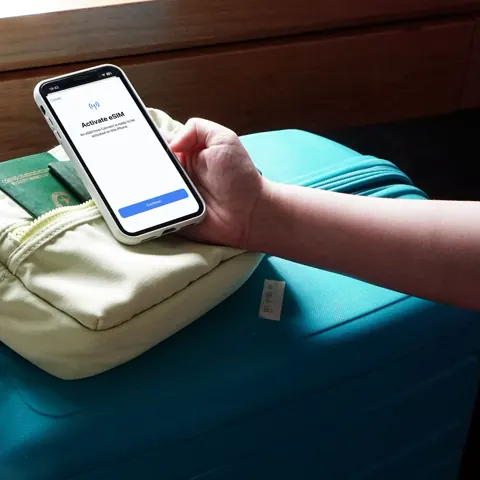
Install the eSIM at home on Wi-Fi a day or two before departure, label it clearly in your phone's settings, and set it as the data line on arrival. Turn data roaming off on your Canadian line to avoid surprise charges. If two people share one plan, confirm that hotspot use is allowed.
Check that your phone is unlocked and eSIM-compatible, confirm whether the plan's validity starts at installation or first connection, and make sure every country on your route is listed if you buy a regional plan.
Safety and Connectivity
Follow current Government of Canada travel advice for Belgium at travel.gc.ca; we do not invent risk scores. In Brussels, pickpocketing is the main concern around busy stations such as Brussels-Midi and Brussels-Nord and in crowded squares. Keep your phone secure on trams and at night markets. Save your accommodation address offline and keep a charged power bank, since you will rely on your phone for tickets and maps.
What Canadians Should Also Know
- Most Canadians combine Belgium with France, the Netherlands or the UK, so confirm a regional plan lists every country on the route.
Frequently Asked About eSIMs in Belgium
Does a Europe regional eSIM work in Belgium?
Will my eSIM work on the Eurostar to London?
Do I need cash in Belgium?
Compare Plans for Belgium
These providers list Belgium on their own sites. Confirm price, validity, data allowance and network before you buy. Order is fixed; providers cannot pay for position. Some links earn us a commission at no cost to you. Disclosure.
- Airalo View Plans
- Yesim View Plans
- Drimsim View Plans
- GigSky See Similar Plans at Yesim
Where This Coverage Data Comes From
| Provider | Source | Checked |
|---|---|---|
| Airalo | Airalo Belgium page | 18 November 2026 |
| Yesim | Yesim Belgium page | 18 November 2026 |
| Drimsim | Drimsim Belgium page | 18 November 2026 |
| GigSky | Similar plans at Yesim Source: gigsky.com/country/esim-in-belgium | 18 November 2026 |
A provider listing a destination does not guarantee coverage everywhere in it. Rural, mountain and offshore areas can have gaps.
How Much Data to Buy for Belgium
For maps, messaging and bookings, most travellers use roughly 0.25–0.5 GB a day. Add more for video calls, social uploads or hotspot use. These are estimates, not provider figures. Use the data calculator for a personal estimate.
More Destinations in Europe
- eSIM for Austria
- eSIM for Czech Republic
- eSIM for Denmark
- eSIM for Hungary
- eSIM for Malta
- eSIM for Norway
- eSIM for Poland
- eSIM for Sweden
 eSIM for Austria
 eSIM for Czech Republic
 eSIM for Denmark
 eSIM for Hungary
 eSIM for Malta
 eSIM for Norway
 eSIM for Poland
 eSIM for Sweden
All destinations · What is an eSIM? · Phone compatibility · eSIM vs roaming